Showing posts with label US EMPSIT. Show all posts

Friday, July 5, 2019

Notes on the U.S. Employment Situation for June 2019: U-rate 3.7%, Jobs +224,000

OVERVIEW

  • Total non-farm payroll employment increased by 224,000 and the unemployment rate rose to 3.7 percent, according to the Bureau of Labor Statistics.  
  • The Labor Force Participation (LFP) rate remained at 62.9 percent the same rate from one year ago. The Employment-Population ratio also remained at 60.6 percent. 
  • Professional and Business Services (+51,000) and Health Care (+35,000) led all sectors in May.  Construction added 21,000 jobs. Manufacturing added 17,000 jobs.
  • Employment in other industries did not change from May to June. Mining, Wholesale Trade, Retail Trade, Information, Financial Activities, Leisure and Hospitality and Government changed little. 
  • Average hourly earnings rose by 6 cents to $27.90. Since June 2018 wages are up 3.1 percent. 
  • In June, the average workweek for all employees remained at 34.4 hours.  
  • The number of persons employed part-time was unchanged in June (4.3 million). The number of long-termed unemployed (greater than 27 weeks) remained unchanged at 1.4 million and accounted for 23.7 percent of all unemployed. 
  • In June 1.6 million persons were not in the workforce but wanted and were available for work and sought employment in the last year. This group known as “workers marginally attached to the labor force” was unchanged since last year. BLS reports that 1.1 million of this group had not searched for work “for reasons such as school attendance or family responsibilities.” 
  • Revisions to the two previous months counted 11,000 less jobs than reported initially. April 2019 was revised from 224,000 to 216,000 while May 2019 was revised from 75,000 to 72,000. 


ANALYSIS

After a weak May payrolls report (+72,000) the U.S. jobs machine roared back with 224,000 new jobs in June. 

Professional and Business Services, Health Care and Transportation and Warehousing sectors lead June’s growth. 

Overall, the jobs machine is clearly slowing down. Employment growth, according to the BLS, has averaged 172,000 this calendar year compared with an average of 223,000 in 2018. 

However, today’s BLS report shattered expectations;  Wall Street expected a gain of 160,000 new jobs. While slower than one year ago, the private sector culled 191,000 new jobs. The parallel measure, the ADP National Employment Report, earlier this week projected a gain of 106,000 private jobs.  

With the BLS revisions, the three-month average for U.S. job growth rang in at 171,000. 

Despite uncertainty about international trade, the U.S. Manufacturing sector is holding its own. The Manufacturing sector added 17,000 jobs in June; while little changed over the past four months, manufacturing is growing albeit slowly. Thus far the sector has averaged 8,000 per month, compared with 22,000 last year. 

The trade-tariff impasse is not diminishing growth in the sector. While the manufacturing sector employs approximately 120,000 less workers than it did before the Great Recession, average hourly wages are rising steadily. (See Figure A.)  

Unemployment in the manufacturing sector declined from June 2018 to June 2019, from 3.1 percent to 2.8 percent. For most part, manufacturing attracts workers on the lower end of educational attainment, but wages are good entry point to the middle class. These workers have also fared well overall in the economy. Unemployment for those with less than a high school degree was 5.8 percent in May. Workers with a high school diploma and no college and some college faced unemployment rates of 3.9 percent and 3.0 percent, respectively. 


Figure A:  Employment and Average Hourly Wages in the U.S. Manufacturing Sector


Friday, May 3, 2019

Note on the April 2019 U.S. Employment Situation: U-Rate 3.6%; Jobs +263,000

OVERVIEW
  • Total non-farm payroll employment increased by 263,000 and the unemployment rate declined to 3.6 percent, moving down 0.2 percentage point from the previous month according to the Bureau of Labor Statistics.  
  • The Labor Force Participation (LFP) rate declined by 0.2 percentage point to 62.8 percent. Nonetheless, the rate was unchanged from a year ago. The Employment-Population ratio also remained at 60.6 percent. Since October 2018, the rate has been either 60.6 percent or 60.7 percent. 
  • Professional and Business Services (+76,000) and Construction (+33,000) led all sectors in the April payrolls. Employment in Health Care (+27,000) did not finish in the top two sectors for growth but along with Professional Services (+535,000) added the most jobs over the past year with Health Care adding +404,000 jobs.
  • With gains in nonresidential specialty trade contractors and in heavy and civil engineering, Construction has added 33,000 jobs. For the year, the sector has added 22,000 jobs. 
  • Manufacturing sector employment (+4,000) changed little for the third month in a row. In the 12 months prior to February 2019 the industry added on average 22,000 jobs per month. 
  • Average hourly earnings rose by 6 cents to $27.77. In April, average workweek for all employees decreased by 0.1 hour to 34.4 hours matching the rate for February 2019.  
  • The number of persons employed part-time held was unchanged at 4.7 million in April. The number of long-termed unemployed (greater than 27 weeks) remained unchanged at 1.2 million and remained to account for 21.1 percent of all unemployed. 
  • The following sectors saw little or no change in employment:  Mining, Wholesale Trade, Transportation and Warehousing, Information, Leisure and Hospitality, and Government.


ANALYSIS

This month’s report is a rebounding blockbuster, considering two months ago the U.S. stock market and policy makers were stunned by the creation of only 56,000 jobs. (The original number was 33,000).  

Wall Street estimated the April payrolls number at 185,000 jobs.  Earlier in the week, the ADP National Employment Report,  estimated the creation of 275,000 new private sector jobs; the BLS reported private sector job creation at 236,000 jobs. 

Retail trade changed little in April; the sector was down 12,000 jobs but the motor vehicle and parts dealers subsector added 8,000 jobs. General merchandise stores suffered a loss of 9,000 jobs. 

Revisions to previous reports were mixed. The February payrolls number was revised upward to 56,000 from 33,000 and the March number was revised down from 196,000 to 189,000. Still the revisions identified 16,000 more jobs than previously reported.  The three-month moving average settled at 169,000 per month. Similar revisions from the earlier three months resulted in a three-month average of 180,000. 

The unemployment rate of 3.6 percent is the lowest since 1969

The current economy, based on supply-side reforms, is benefiting workers and instilling confidence in consumers. Not so long ago, market watchers were worried about the slowdown in consumer spending as a bellwether of an almost certain downturn. 

On Thursday, the BLS reported than nonfarm business sector labor productivity increased 3.6 percent in the first quarter of 2019, with output increasing by 4.1 percent and hours worked increased 0.5 percent. Along with productivity (another blow-out number), the job market is at a sweet spot. 

Today’s report noted that average hourly earnings over the past year have increased by 3.2 percent.  Workers and consumers are more careful about how they treat homeowner equity which is 16 percent higher than 2006, the advent of the Great Recession. Apparently increased wages serve as a bulwark against reckless home equity borrowing. 

As a result, workers are saving more. The article to read is “Why Are Americans Suddenly Saving?” by Matthew C. Klein in Barron’s on April 22, 2019.


Source: Author’s calculations based on BLS and US Census historical data (Total Retail Sales)


Conte Consulting:  Editorial Services | Web Content Design & Management |Public Policy Analysis

Friday, April 5, 2019

Notes on the March 2019 U.S. Employment Situation: U-Rate: 3.8%; Jobs: +196,000

OVERVIEW
  • Total non-farm payroll employment increased by 196,000 and the unemployment rate remained 3.8 percent, according to the Bureau of Labor Statistics.  
  • The Labor Force Participation (LFP) rate was little changed at 63.0 percent. This gauge of employment has hardly moved over the past year. The Employment-Population ratio also remained at 60.6 percent.  
  • Health Care (+49,000) and Professional and Business Services (+34,000) led all sectors in the March payrolls. Both sectors led job creation over the past twelve months with 398,000 and 311,000 jobs, respectively. 
  • According to the BLS, the following sectors saw little or no change in employment:  Mining, Wholesale Trade, Retail Trade, Transportation and warehousing, Information, Financial Activities and Government.
  • After adding 1,000 jobs in February, the Manufacturing sector lost 6,000 jobs, almost all of those jobs in motor vehicles and parts. 
  • Average hourly earnings rose by 4 cents to $27.70. In March, average workweek for all employees rose by 0.1 to 34.5 hours after seeing a decline in February by 0.1 hour. 
  • Employment continued to trend up in Food services and drinking places in March (+27,000), in line with its average monthly growth over the prior 12 months said BLS.
  • The number of persons employed part-time held steady at 4.5 million in March.
  • The number of long-termed unemployed (greater than 27 weeks) remained unchanged at 1.3 million. This group represents 21.1 percent of all unemployed.

ANALYSIS


Anyone looking for a stronger revision to the February employment situation report of 20,000 jobs will be disappointed by the final print for the month: 33,000.  That new number was the weakest since September 2017.

Even January was revised upward only slightly from the February-revised 311,000 to 312,000. 

The BLS said the revisions resulted in a three-month average of 180,000 (down for the same period for the first quarter of 2018).  

Still today’s number, a positive snap-back, encouraged some optimism. The headline of 196,000 new jobs did top Wall Street expectations of 180,000 for the month. Marvin Loh, global macro strategist at State Street, told Yahoo News that the March jobs report will be “the first clean one in a while” now the fallout from the government shutdown is mostly over. 

The widely-read ADP payroll processing firm survey earlier this week reported a gain of 129,000 private sector jobs, the BLS contrasted with 182,000 jobs. 

The question remains the cohort that is still sidelined from the job growth of the past decade. The BLS reports that 95.5 million were out of the labor force compared to 95.4 last March The employment-population ratio was 60.6 percent in March; the BLS noted that this ratio has been either 60.6 or 60.7 percent since October 2018. 

Two closely-watched indicators, persons marginally attached to the labor force and discouraged workers have changed little over the past year. 

This report also showed ongoing upside. The unemployment status by educational attainment showed declines among the four major groups. The unemployment rate for workers with a high school diploma but no college declined from 4.7 in March 2018 to 3.7 in March 2019. Those with the bachelor’s degree or more continue to see lower unemployment at 2.0 percent. 

The American jobs machine continues to grow over a longer-term horizon. Since January 2007, months before the Great Recession, the American economy has added 12.9 million jobs with the construction, manufacturing and information sectors the only losers over this period. (See chart.)

Source: Author’s calculations based on BLS historical data
Conte Consulting:  
Editorial Services |Web Content Design & Management|Public Policy Analysis

Friday, February 1, 2019

US EMPSIT: January 2019: U-Rate: 4.0%; Jobs: +304,000

OVERVIEW

  • The unemployment rate rose slightly to 4.0 percent in January with payrolls expanding by 304,000 jobs, according to the Bureau of Labor Statistics.  
  • The Labor Force Participation (LFP) rate changed little at 63.2 percent. The Employment-Population ratio also remained at 60.7 percent. Both measures are up 0.5 percentage points over the year. 
  • Job gains took place in Leisure and Hospitality (+74,000) and Construction (+52,000) Health Care (+42,000) and Transportation and Warehousing (+27,000) In addition, Professional and Business Services added 30,000 jobs.
  • According to the BLS, the following sectors saw little or no change in employment:  Wholesale Trade, Information and Financial Activities. 
  • Over the year, average hourly earnings have increased by 85 cents or 3.2 percent. In January, the average hourly private nonfarm wage rang in at $27.56. The average workweek for all employees was unchanged at 34.5 hours. 
  • The number of persons employed part-time increased to 5.1 million in January, most of it coming from the private sector and due to the shutdown.
  • The number of long-termed unemployed (greater than 27 weeks) remained unchanged at 1.3 million. 


ANALYSIS

If anyone was looking for the federal government shutdown to pause the American jobs machine, they will have to look elsewhere. The economy entered its 100th straight month of increased employment. 

According to the latest measurement, the shutdown had minimal impact on job creation with the payrolls number arriving at 304,000.  

Wall Street economists expected a January print of approximately 170,000 jobs.  

On Wednesday, ADP, the payroll processing company, reported an increase of 213,000 private sector jobs in January. Today, the BLS reported the economy created 296,000 private sector jobs. Both measures generally track together (See chart above). 

According to the BLS, federal government employment was unchanged in January. The agency explained: “Federal employees on furlough during the partial government shutdown were counted as employed in the establishment survey because they worked or received pay (or will receive pay) for the pay period that included the 12th of the month.” 

Revisions to the two previous months resulted in a decline of 70,000 jobs. The November 2018 number was revised up from +176,000 to +196,000. However, the December number was revised downward from +312,000 to +222,000. 

The decline is explained by the BLS adjustment of its annual benchmarking process. Accounting for these revisions, the three-month average rang in at 241,000 per month. 

Conte Consulting:  Editorial Services | Web Content Design & Management |Public Policy Analysis

Friday, November 2, 2018

Notes on today's U.S. jobs report: A 3.7% unemployment rate and 250,000 new jobs

OVERVIEW

  • The unemployment rate remained at 3.7 percent in October with payrolls expanding by 250,000 jobs, according to the Bureau of Labor Statistics
  • According to the BLS, Hurricane Michael, which fell while the agency collected data, had no noticeable effect on job estimates.
  • The Labor Force Participation (LFP) rose 0.02 to 62.9 percent. The Employment-population ratio also finished up for the month at 60.6 percent. The number of unemployed for the month was 6.1 million representing a decline over the year of 449,000 persons. 
  • Job gains took place in, Health care (+36,000), Manufacturing (+32,000), Construction (+30,000) Professional and business services (+35,000) and the Transportation and warehousing sector (+25,000).
  • Mining grew by 5,000 jobs in October while Leisure and hospitality gained 42,000 withstanding the impact of Hurricane Florence. While employment was unchanged in this sector, the two-month growth matched the 12-month average at 21,000 per month.
  • In addition, according to the BLS, the following sectors saw little or no change in employment: Wholesale trade, Retail trade, Information, Financial activities and Government.
  • Over the year, average hourly earnings have increased by 83 cents or 3.1 percent. In October, the average hourly private non-farm wage rang in at $27.30, an increase of five cents. The average workweek for all employees clocked in at 34.5 hours.
  • The number of persons employed part-time for economic reasons was unchanged at 4.6 million. The number of long-term unemployed also changed little at 1.4 million. This group represents 22.5 percent of all unemployed persons.


ANALYSIS


Total nonfarm payroll employment rose by 250,000 in October.  Not knowing how to gauge weather interruptions from last month, Wall Street forecasts provided a wide range of payroll increases between 105.000 to 253,000  jobs. 

The BLS revised numbers for September downward (from 134,000 to 118,000) and upward for August (from 270,000 to 286,000). These revised figures show that job gains have averaged 218,000 over the past three months. 
The BLS reported 246,000 new private sector jobs were created compared with the ADP payrolls report released earlier this week of 227,000 private payrolls.  

The continued growth in the manufacturing sector emerged as one of the highlights on today’s report. The sector has added 296,000 jobs over the past year— most of it coming from durable goods production. Here, in this sector, the workweek remained steady at 40.8 hours. 

While the economy is at full employment, worker productivity is lagging. Output, the amount produced by workers, has been sluggish. At 1.3 percent in the most recent measure, productivity has failed to surpass 2 percent for the last 32 quarters. Nearly two decades ago, productivity gains fell regularly in the 3 percent range. 

According to the Wall Street Journal, Chicago Fed President Charles Evans noted the importance of productivity to the nation’s long-term growth in speech earlier this year. “Higher sustainable growth would be great. However, we can’t get there without boosting the underlying trends in labor input or productivity,” Mr. Evans said. 

Manufacturing sector labor productivity increased 0.5 percent in the third quarter, according the third quarter report released earlier this week.  There’s some good news for workers: Average hourly earnings have recovered from the Great Recession but still below the 2008 pre-recession peak. Labor force participation, which has languished as a result of the retiring baby-boom workers inched up by 0.2 percentage point over the year.  These two trends point to mounting pressures on the Federal Reserve Bank to stick to its plan to raise interest rates through 2019.

Friday, September 7, 2018

U.S. Employment Situation August 2018: U-Rate: 3.9%; Jobs: +201,000

OVERVIEW
  • The unemployment rate remained 3.9 percent in August with payrolls expanding by 201,000 jobs, according to the Bureau of Labor Statistics.
  • The Labor Force Participation (LFP) declined to 62.7 percent. The Employment-population ratio also declined in August by 0.2 to 60.3 percent. The number of unemployed for the month was 6.2 million, little changed from July. 
  • Among the major groups, the unemployment rate for adult men was 3.5 and 3.6 percent, respectively. Among minority groups, unemployment was 6.3 percent (Blacks), 3.0 percent (Asians) and 4.7 percent (Hispanics). 
  • In August, employment grew in the Wholesale trade, Health care, Professional services, Transportation and warehousing, and Mining.
  • Professional and business services added 53,000 jobs. 
  • Wholesale trade added 22,000 jobs while Health care added 33,000. Wholesale trade benefited from the growth in durable good wholesale subsector while health care benefited from gains in the ambulatory and hospital subsectors.
  • Manufacturing changed little in August. 
  • Month over month, employment in the other major sectors—Retail trade, Financial activities, Leisure and hospitality—changed little. 
  • Over the year, average hourly earnings have increased by 77 cents or 2.9 percent. In August the average hourly private nonfarm wage rang in at $27.16.
  • The average workweek for all employees was unchanged at 34.5 hours. 
  • The number of persons employed part-time for economic reasons changed little over the month but was down by 830,000 over the year.
ANALYSIS

Job growth continued into August with 201,000 payroll jobs added. The consensus estimate centered around 191,000, according to CNBC

Employment growth in August fell in line with the average monthly growth of 196,000 for the past 12 months. 

The BLS reported that 204,000 private sector jobs were created during the month. Earlier in the week, ADP reported an increase of 163,000 nonfarm private sector jobs for August.  Hindsight took some —but not much— enthusiasm out of previous two monthly payrolls reports.  The BLS revised the payroll number for June 2018 to 208,000 from 248,000 and did the same for July 2018 — revising that month’s number to 147,000 from the 157,000 previously reported. 

Examining five years of August data, economists expect the month’s numbers to be revised upward. The new numbers show the three-month average showed up at the rate of 185,000 jobs. The number of long-term unemployed (for more than 27 weeks or more) was little changed in August although over the past year the number had declined by 403,000. This group accounted for 21.5 percent of U.S. unemployment. 

The energy sector, after a near two-year slump, generated 104,000 jobs “almost entirely in support activity for mining.”  

Manufacturing is at a sweet spot, while employment changed little in this sector, employment was up by 254,000 with more than three fourths coming the durable goods segment. 

The latest jobs and wages reports provide little ammunition for doves at the Federal Reserve Bank. There are no reasons to keep interest rates low. The Fed wanted to see growth in wages before hiking and its clear wages are moving in the right direction. 

The economy is at a peak. Business confidence is up and supported by consumer optimism. “Today’s strong economy is finally translating into wage gains for more workers,” Andrew Chamberlain, chief economist of the labor-market research firm Glassdoor told MarketWatch.


Saturday, August 4, 2018

Note on the U.S. Employment Situation: July 2018 - 3.9% U-Rate; +157,000 jobs

OVERVIEW

  • The unemployment rate declined to 3.9 percent in July with payrolls expanding by 157,000 jobs, according to the Bureau of Labor Statistics.
  • The Labor Force Participation (LFP) remained at 62.9 percent. The employment-population ratio rose in July to 60.5 percent; it has increased by 0.3 percentage point over the year. The number of unemployed for the month was 6.3 million. Since last year 676,000 persons left the status of unemployment. 
  • In July employment grew in the manufacturing, health care, construction and professional services.
  • Manufacturing added 37,000 jobs with durable goods manufacturing accounting for most of the gain. Over the past year manufacturing has added 327,000 jobs.  
  • Professional and business services added 51,000 jobs. This sector has added 518,000 jobs over the past year. 
  • Employment in the other major sectors—mining, wholesale trade, transportation and warehousing, information, financial activities, and government —changed little over the month.
  • Over the year, average hourly earnings have increased by 71 cents or 2.7 percent.
  • Among major worker groups he jobs rates remained unchanged except for adult men and Whites. 


ANALYSIS

The U.S. economy added 157,000 jobs failing to meet the consensus figure of 190,000.  However, the report looks even better when considering the moving three-month average of 224,000. That’s because figures for the previous two-months were revised upward (+244,000 to +268,000 for May and +213,000 to +248,000 for June). 

The number of part-time workers was little changed in July at 4.6 million but declined by 669,000 over the past year. The number of long-term unemployed (more than 27 weeks) also was unchanged at 1.4 million. This group accounts for 22.7 percent of all unemployed. 

Retail trade changed little with an increase of 7,000 jobs; those gains were essentially wiped out by the decline of 32,000 jobs in sporting goods, hobby, book and music stores. Manufacturing continues to grow although it is far from pre-recession levels. (See chart.) 

Manufacturing grew in the transportation equipment subsector (+13,000), machinery (+6,000) and electronic instruments (+2,000).  Manufacturing has not recovered the jobs lost after the onset of the Great Recession.  It is unclear how the pending trade and tariff wars will play out in the job market over the next few months.  Opinions are varied.  "While the ongoing trade dispute may discourage businesses to invest and hire down the road, today's jobs report suggests the jobs market is not yet collateral damage," said Beth Ann Bovino, chief U.S. economist at S&P Global Ratings in New York.

Friday, July 6, 2018

June 2018 Employment Situation: U-Rate: 4.0%; Jobs: +213,000

OVERVIEW

  • The unemployment rate rose to 4.0 percent in June with payrolls expanding by 213,000 jobs, according to the Bureau of Labor Statistics.
  • The Labor Force Participation (LFP) edged up by 0.2 percentage point to 62.9 percent. The employment-population ratio was unchanged in June at 60.4 percent and has remained flat since February. The number of unemployed for the month of June was 6.6 million. One year ago, that number was 7.0 million. 
  • In June employment grew in the manufacturing, health care, construction and mining sectors.
  • Manufacturing added 36,000 jobs with durable goods manufacturing accounting for most of the increase. 
  • Professional and business services added 50,000 jobs. This sector has added 521,000 jobs over the past year. Retail lost 22,000 jobs in June offsetting May’s gain of 25,000 jobs. 
  • Employment in the other major sectors—wholesale trade, transportation and warehousing, information, financial activities, leisure and hospitality and government —changed little over the month.
  • The average duration of unemployment declined over the past year from 24.9 to 21.2 weeks.

ANALYSIS

The U.S. economy added 213,000 jobs beating economists’ expectations in the range of 200,000 and 195,000 jobs. 

The report looks even better when considering the revisions. April’s report was revised upward to 175,000 jobs from the previously reported 159,000 and May’s report was revised upward to 244,000 from 223,000. The BLS reported that after these revisions, job gains have averaged 211,000 per month over the last three months. 

The private sector created 202,000 new jobs, a figure higher than this week’s ADP report for the same month (+177,000). 

The unemployment rate rose to 4.0 percent from 3.8 percent but remains lower than 12 month ago (4.3 percent). The increase may be attributable to the 0.2 percentage point increase in labor force participation over the past month. 

Over the past year the manufacturing sector has added 285,000 jobs, an impressive number that will be tested as trade disputes intensify with new tariffs on foreign goods. 

Average hourly earnings for all employees rose by five cents to $26.98, representing a gain of 2.7 percent over the past year. The average work week remained at 34.5 hours. 

The number of long-term unemployment increased by 289,000 to 1.5 million. These individuals who have been unemployed for more than 27 weeks account for 23 percent of all unemployed. The percent distribution of this group has increased over the past five months suggesting the hardships of returning to work after long periods of unemployment.


Friday, April 6, 2018

March 2018 U.S. Employment Situation -- U-rate, 4.1 percent; Payrolls +103.000

OVERVIEW

  • The unemployment rate remained at 4.1 percent for the sixth consecutive month in March with payrolls expanding by 103,000 jobs, according to the Bureau of Labor Statistics.
  • The Labor Force Participation (LFP) changed little at 62.9 percent. The employment-population ratio was unchanged at 60.4 percent.
  • In March the employment grew in the manufacturing, health care and mining sectors with the durable goods sub-sector accounting for approximately three-fourths of the gain in manufacturing. 
  • Health care added 22,000 jobs a gain consistent with the past 12-month average while construction slowed down after a February gain. 
  • Professional and business services added 33,000 jobs. This sector has added 502,000 jobs over the past year.
  • After increasing 47,000 in February, retail lost 4,000 jobs in March. 
  • Employment in the other major sectors—wholesale trade, transportation and warehousing, information, financial activities, leisure and hospitality and government —changed little over the month.
  • Average hourly earnings for all employees rose by 8 cents to $26.82, representing a gain of 2.7 percent over the past year. The average work week remained at 34.5 hours.


ANALYSIS
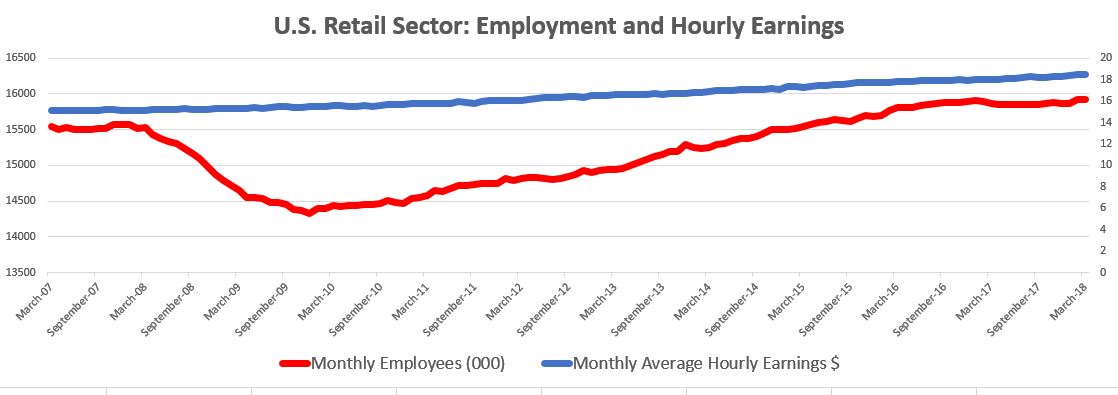
The March payroll jobs report could best be summed up as “less than stellar.” Economists were expecting a monthly gain of between 185,000 and 193,000 jobs. Most economists believe the U.S. economy has reached full employment with some worrying about running out of workers because of fast job growth. However, the number of involuntary part-time workers remained unchanged at 5 million while the number of marginally attached workers checked in at 1.5 million persons, a number not much different from last year. The number of part-time workers in the labor pool increased from 20.7 million in March 2017 to 21.3 million in March 2018. The retail sector returned to its current state of “disliked normalcy” with employment declining by 13,000 jobs in general merchandise stores, “offsetting a gain of the same size in February,” according to the BLS.  Earnings in this sector have bounced back a bit since a decline that began in 2016 (See chart below). The LFP rate decreased from both February 2018 (month over month) and March 2017 (year over year). Today’s report included good news. Average hourly earnings have increased by 71 cents over the past year. Paul Ashworth, chief U.S. economist at Capital Economics, told Bloomberg News that despite the weak payrolls gain, "There is still evidence of an acceleration in the underlying pace of employment growth… looking through the volatility, employment growth is trending higher and wage growth is starting to heat up.”  As a result, pressure will build on the U.S. Federal Reserve Bank to abide by its commitments to raise rates this year.


Friday, February 2, 2018

Notes on today's U.S. payrolls number and unemployment rate: +200,000 jobs; 4.1 percent


OVERVIEW

  • The unemployment rate remained at 4.1 percent for the fourth consecutive month in December while payrolls expanded by 200,000, according to the Bureau of Labor Statistics.
  • The Labor Force Participation (LFP) remained at also remained at 62.7 percent for the fourth straight month. The employment-population ratio was unchanged at 60.1 percent for the third straight month. 
  • Construction added 36,000 jobs in January. 
  • Employment in food services and drinking places added 31,000 jobs while employment in health care added 21,000 with 13,000 of those jobs in hospitals. 
  • The manufacturing sector added 15,000 jobs continuing a trend.  In the past 12 months, the sector has added 186,000 jobs.
  • Employment in the other major sectors— mining, wholesale trade, retail trade, transportation and warehousing, information, financial activities, professional services and government —changed little over the month. 
  • The November 2017 number was revised downward from 252, 000 to 216,000 and the December 2017 payrolls number was revised up from 148,000 to 160,000.

ANALYSIS

After a disappointing December print, the labor market picked up in January. After revisions to earlier reports, job gains averaged 192,000 months for the past three months. A survey of Wall Street Journal economists expected an increase of 177,000 jobs. According to an ADP report earlier this week, private sector employment increased by 234,000 jobs in January.  Also, this past week saw a Labor Department report showing that initial claims for state unemployment benefits slipped 1,000 to a seasonally adjusted 230,000 for the last week of the month. According to Reuters this represents the 152nd week of claims settling below the 300,000 threshold associated with a strong economy.  Wage growth underscores the tight labor markets.  This wage growth is the fastest since the Great Recession.  However, the labor force participation rate remains low by historical standards; the rate only declined by one-tenth of a percentage point since last January.  In addition, the broader measure which includes discouraged workers, the U-6 rate increased to 8.2 percent. The decline in African-American workers proved to be a bump. After falling to 6.8 percent in December, the rate for black workers rose to 7.7 percent last month. Despite the recent wage increases overall, the lower-wage food services and drinking places sector grew faster than higher wages sectors such as professional and technical services over the past 10 years. (See chart below.)  


Friday, January 5, 2018

Manufacturing says "See you in December": BLS: NFP +148,000 U-Rate 4.1%


OVERVIEW

  • The unemployment rate remained at 4.1 percent for the third consecutive month in December while payrolls expanded by 148,000, according to the Bureau of Labor Statistics.
  • The Labor Force Participation (LFP) remained at 62.7 percent. The employment-population ratio was unchanged at 60.1 percent. 
  • Employment in health care increased by 31,000 while construction added 36,000 jobs. 
  • The manufacturing sector added 25,000 jobs. The BLS reports that this sector added 196,000 jobs in 2017 after a dismal 2016 which saw a loss of 16,000 jobs. 
  • Professional and business services kept pace in 2017 with the previous year adding 44,000 jobs per month. In December, the sector added 19,000 jobs 
  • Employment in the other major sectors— mining, wholesale trade, transportation and warehousing, information, financial activities and government —changed little over the month. 
  • Over the year, the BLS reports the unemployment rate and the number of unemployed were down by 0.6 percentage point and 926,000, respectively.


ANALYSIS

In December, the American jobs machine took a breather. The payroll employment (+148,000) fell below the Wall Street consensus of 190,000 jobsAccording to an ADP report earlier this week, private sector employment increased by 250,000 jobs in December.  The unemployment rate for the major work groups remained low. The unemployment rate for African-Americans fell to 6.8 percent the lowest ever.  The retail sector fared better under the last year of the previous administration where it increased by 203,000 in 2016. In 2017 it lost 67,000. Employment in general merchandise edged down in 2017 shedding 67,000 jobs. However, Manufacturing added 196,000 jobs in 2017 following little net change in 2016. The November employment report was revised up from +228,000 to +252,000 and the change in October was revised down from +244,000 to +211,000 (Combined over two months, a net loss of 9,000 jobs). Over the past three months, job gains have averaged 204,000 a month.  In December, average hourly earnings for all employees increased by 9 cents to $26.63; over the past year, hourly earnings have risen by 65 cents or 2.5 percent. The labor force participation rate has not changed over the year. It remains at 62.7 percent.  The number of workers employed part-time for economic reasons has declined by 639,000 over the past year.  


Friday, December 8, 2017

US EMPSIT November 2017: 4.1 percent U-Rate; Payrolls +228,000


OVERVIEW
  • The unemployment rate remained at 4.1 percent in November while payrolls expanded by 228,000, according to the Bureau of Labor Statistics.
  • The Labor Force Participation (LFP) remained at 62.7 percent for November. The employment-population ratio was little changed at 60.1 percent. 
  • The manufacturing sector added 31,000 jobs. The BLS reports “that since a recent low in November 2016, manufacturing has increased by 189,000 jobs.”
  • Professional and business services added 46,000 jobs in November and health care added 30,000. 
  • Employment in the other major sectors— mining, wholesale trade, retail trade, transportation and warehousing, information, leisure and hospitality, financial activities and government —changed little. 
  • In November, average hourly earnings for all employees increased by 5 cents to $26.55; over the past year, hourly earnings have risen by 64 cents or 2.5 percent. 
  • The September employment report was revised up from +18,000 to +38,000 and the change in October was revised down from +261,000 to +244,00 Over the past three months, job gains have averaged 170,000 a month.  The six-month average monthly growth is 177,600. From January, the economy added on average 174,000 monthly jobs.

ANALYSIS

In November, the American factory kicked into high gear. Since last year the manufacturing sector has added 189,000 jobs. Subsector growth took place in machinery (+8,000), fabricated metal products (+7,000), computer and electronic products (+4,000), and plastics and rubber products (+4,000).  The payroll employment report exceeded the  Wall Street consensus of 200,000 jobs.  According to an ADP report earlier this week, private sector employment increased by 190,000 jobs in November. The unemployment rolls decreased over the past 12 months by 799,000 workers. The number of part-time for economic reasons remained at 4.8 million. Nonetheless, there is talk of a labor shortage in the manufacturing sector where employers are investing in resources to train new workers and by increasing automation.  The tight labor market suggests that wages should be  increasing faster that today’s reported annual rate of 2.5%. But percentage growth in lower paid jobs since 2007 in the leisure and hospitality sectors (0.2) have outstripped high-value-adding professional and business services (0.1) and the overall job (0.1) growth (See table below). Another view is more generational than structural. According to USAToday, “Some economists say the government's measure of average earnings growth may be skewed downward by the retirements of higher-paid Baby Boomers and the entry into the labor force of lower paid Millennials.” For now, holding a job is more important than higher wages. Overall, the job market is on solid ground giving the Federal Reserve an opportunity to raise rates.


PDF version of this post.

Friday, July 7, 2017

Analysis of US EMPSIT U-Rate 4.4%; Jobs added: 220,000;

OVERVIEW
  • The unemployment rate rose to 4.4 percent in June while payrolls expanded by 222,000, according to the Bureau of Labor Statistics.
  • The Labor Force Participation (LFP) rate rose by 0.1 percentage point to 62.8 percent for June. The employment-population ratio was little changed at 60.1 percent.
  • Health care added 37,000 jobs and social assistance added 23,000 jobs.
  • Employment in the other major sectors— construction, manufacturing, wholesale trade, retail trade, transportation and warehousing, information and government —were unchanged.
  • Employment in the financial activities sector rose by 17,000 in June after stalling in May.
  • In June, average hourly earnings for all employees increased by 4 cents to $26.25, representing a 2.5 percent year over year increase.
  • In June, employment in the professional services sector rose by 35,000.
  • The April employment situation report was revised up from 174,000 to 207,000 and the change from May was also revised up from the 138,000 to 152,000.  The two-month revisions accounted for 47,000 jobs that were previously not identified.
  • The average workweek for all employees rose by 0.1 hour to 34.5 hours.


ANALYSIS
The payroll employment report highlighting 220,000 new jobs exceeded the Wall Street consensus of 170,000 jobs.  The new number arrived as a pleasant surprise. According to an ADP report earlier this week, private sector employment increased by 158,000 jobs from May to June. According to the BLS, employment growth has averaged 180,000 per month thus far this year — slightly below the 2016 average monthly gain of 187,000.   


The positive news in today’s report underscores that since January, the unemployment rate and the number of unemployed are down by 0.4 percentage point and 658,000. The rolling three-month average with the new revisions indicate job gains of 194,000 a month. 

However, the LFP rate continues to plague the jobs recovery; it has changed little from 62.8 percent and shows “no clear trend over the past year.” The number of persons employed part-time (but who would like more hours), was little changed at 5.3 million. In June, 1.6 million persons were marginally attached to the labor force, down by 197,000.  

The BLS estimates that 1.1 million persons marginally attached remain out of the workforce for reasons such as family responsibilities and school attendance. Teen-age unemployment has trimmed down from 15.9 percent last June to 13.3 percent in June 2017. 

Relative to the growth in jobs, wage gains remain weak. The report "is another illustration that the real economy is in good health," said Paul Ashworth, chief U.S. economist at Capital Economics. "The only disappointment is that wage growth still shows few signs of accelerating."

PDF version of this Research Note

Friday, June 2, 2017

Quick take on today's jobs numbers: U-Rate: 4.3%; Jobs: +138,000

OVERVIEW

The unemployment rate declined to 4.3 percent in March while payrolls expanded by 138,000, according to the Bureau of Labor Statistics.
The Labor Force Participation (LFP) rate declined by 0.2 percentage point to 62.7 percent for May. The employment-population ratio also declined by 0.2 percentage point to 60.0 percent.
Employment rose in mining and health care, +7,000 and +24,000 respectively. 
Employment in the other major sectors— construction, manufacturing, wholesale trade, retail trade, transportation and warehousing, information, financial activities and government —were unchanged. 
In May, average hourly earnings for all employees increased by 4 cents to $26.22, representing a 2.5 percent year over year increase. 
In May, employment in the professional services sector remains strong keeping up with the average gains for 2016. 
The March employment situation report was revised down further to 50,000 from 79,000 originally reported. April’s increase in jobs was also revised downward from 211,000 to 174,000.  Over the past three months, job gains averaged 121,000. 
The average workweek for all employees was unchanged at 34.4 hours.


ANALYSIS


The payroll employment report fell well below Wall Street consensus of 180,000 jobs and below the 12-month average of 181,000. The BLS private sector employment reported 123,831 private sector jobs. According to an ADP report earlier this week, private sector employment increased by 253,000 jobs from April to March. The number of persons employed part-time (but who would like more hours), was little changed at 5.2 million suggesting the growing jobs market isn’t matching worker needs. Employment in mining, (which covers the oil and gas extraction industries) has increased by 47,000 since October 2016. Employment in food and drinking places also continued to move upward. In the last 12 months, this sector has added 267,000 jobs. The battered retail sector appeared to stem previous losses; job payrolls showed little change since April. The heavily government-funded health care sector continued to grow with hospitals adding 7,000 jobs. However current year to date average monthly growth is down at 22,000 per month compared to 32,000 for 2016. "This report is clearly soft in every material respect relative to expectations and relative to last month. That's a disappointment," said Eric Winograd, U.S. economist at Alliance Bernstein. However, he added, "I don't think it's soft enough to cause a fundamental rethink of the economic outlook."  Economists will now wait for the Federal Reserve Bank to weigh the new payrolls number as it adjusts monetary policy.


The nation's health care sector grows even during recessions. 

Friday, May 5, 2017

Comments on the April 2017 BLS jobs report: U-Rate: 4.4%; Jobs: + 211,000

OVERVIEW 
* The unemployment rate declined to 4.4 percent in March while payrolls expanded by 211,000, according to the Bureau of Labor Statistics

* The Labor Force Participation (LFP) rate remained virtually the same as the previous month at 62.9 percent for April. The employment-population ratio also changed little at 60.2 percent 

* Employment rose in leisure and hospitality, health care and social assistance, financial activities and mining. 

* Employment in construction, manufacturing, wholesale trade, retail trade, transportation and warehousing, information and government were unchanged since March. 

* In April, the BLS reported that average hourly earnings for all employees increased by 7 cents to $26.19, representing a 2.5 percent year over year increase. 

 * Employment in mining rose by 9,000. The BLS noted a rebound off an October 2016 low, with the sector adding 44,000 since then. 

 * Employment in the professional services sector has grown by 612,000 over the past 12 months. 

 * The original and disappointing March employment situation report was revised down from an 98,000 increase to just a 79,000 increase. However, February was revised up from 219,000 to 232,000. 


Civilian Unemployment Rate 2007-present

ANALYSIS 

The payroll employment report beat Wall Street consensus of 191,000 jobs. The BLS private sector employment estimate arrived at 194,000 jobs beating another estimate. According to the ADP report earlier this week, private sector employment increased by 177,000 jobs from March to April. 

Over the past three months, the economy has added, on average, 174,000 jobs a month. The number of long-term unemployed (greater than 27 weeks) was unchanged. The number of involuntary part-time workers declined by 281,000 in April. 

The average workweek for all private payrolls increased by 0.1 hour to 34.4 hours. 

The Leisure and Hospitality sector led the April report with 55,000 new jobs. Since the end of the recession, the sector has gained approximately one percent in the share of total jobs in the U.S. private economy. 

The BLS noted that while Health Care and Social Assistance increased by 37,000 jobs in April, that number is below “the average gain of 32,000 per year.” Financial activities added 19,000 jobs with 14,000 of those jobs coming in the insurance sector. 

The LFP rate has changed little since February 2016. “Two hundred thousand for jobs growth is just such a huge number, you’d think we’d get to a point where employers have to raise wages, and we’re still not seeing it,” Tara Sinclair, an economist at George Washington University told the Washington Post. Even with a healthy job market, that wage goal remains elusive for workers.

PDF version of Research Note.

Friday, April 7, 2017

March 2017 Jobs Report: Rate drops to 4.5 but economy only adds 98,000 jobs

OVERVIEW
  • The unemployment rate declined to 4.5 percent in March while payrolls expanded by 98,000, according to the Bureau of Labor Statistics.
  • The Labor Force Participation (LFP) rate remained at 63.0 percent. 
  • The number of persons working part-time for economic reasons was little changed at 5.6 million. 
  • The number of those individuals “marginally attached to the labor force,” also remained unchanged.
  • Retail jobs lost 30,000 positions in March.  General merchandise stores declined by 35,000. 
  • Following gains of 219,000 in February and 216,000 in January, March employment only edged up by 98,000. 
  • Mining added 11,000 bouncing back from an October 2016 low. 
  • Professional and Business Services led the gains by adding 56,000 jobs. BLS reports the growth in this sector has kept pace with the average monthly gain over the past 12 months.
  • The previous two months’ figures were revised downward. January’s report was revised downward from 238,000 to 216,000 and February’s report was revised downward from 235,000 to 219,000 jobs. 

ANALYSIS

The unexpectedly weak jobs report— along with the downward revisions to January and February numbers —suggest there may be something more at work than last month’s weather. Wall Street expected a gain of 175,000 jobs.

Moreover, today’s report stands in stark contrast with the ADP report released this week estimated the addition of 263,000 jobs in March.

Professional and Business Services continued to notch gains on the strength of “services to buildings and dwellings (+17,000) and architectural and engineering services (+7,000). The Health Care sector continues to post jobs gains with 20,000 per month for 2017. Construction employment changed little, however today’s report noted that jobs have “been trending up since late last summer, largely among specialty trade contractors and in residential building.”

The average workweek was unchanged at 34.3 hours. Average hourly earnings for all private sector employees increased by 5 cents to $26.14, following a 7-cent increase in February.

O
ver the past year, these earnings have increased by 2.7 percent.  The retail sector continues to struggle, with major firms announcing job cuts and store closings. Approximately 15.8 million workers have jobs in the retail sector, overall.  

Of that number, 3.1 million are in general merchandise stores representing 19.6 percent of the retail workforce. The slowly growing but influential and tech-driven “non-store” retail sector comprises 3.5 percent of the retail workforce.  In March 2016 nonstore retailers employed 521,800 workers compared to 555,700 workers today, a gain of 33,900 workers.

Indicators

Test