Showing posts with label Composition of Jobs. Show all posts

Friday, April 6, 2018

March 2018 U.S. Employment Situation -- U-rate, 4.1 percent; Payrolls +103.000

OVERVIEW

  • The unemployment rate remained at 4.1 percent for the sixth consecutive month in March with payrolls expanding by 103,000 jobs, according to the Bureau of Labor Statistics.
  • The Labor Force Participation (LFP) changed little at 62.9 percent. The employment-population ratio was unchanged at 60.4 percent.
  • In March the employment grew in the manufacturing, health care and mining sectors with the durable goods sub-sector accounting for approximately three-fourths of the gain in manufacturing. 
  • Health care added 22,000 jobs a gain consistent with the past 12-month average while construction slowed down after a February gain. 
  • Professional and business services added 33,000 jobs. This sector has added 502,000 jobs over the past year.
  • After increasing 47,000 in February, retail lost 4,000 jobs in March. 
  • Employment in the other major sectors—wholesale trade, transportation and warehousing, information, financial activities, leisure and hospitality and government —changed little over the month.
  • Average hourly earnings for all employees rose by 8 cents to $26.82, representing a gain of 2.7 percent over the past year. The average work week remained at 34.5 hours.


ANALYSIS
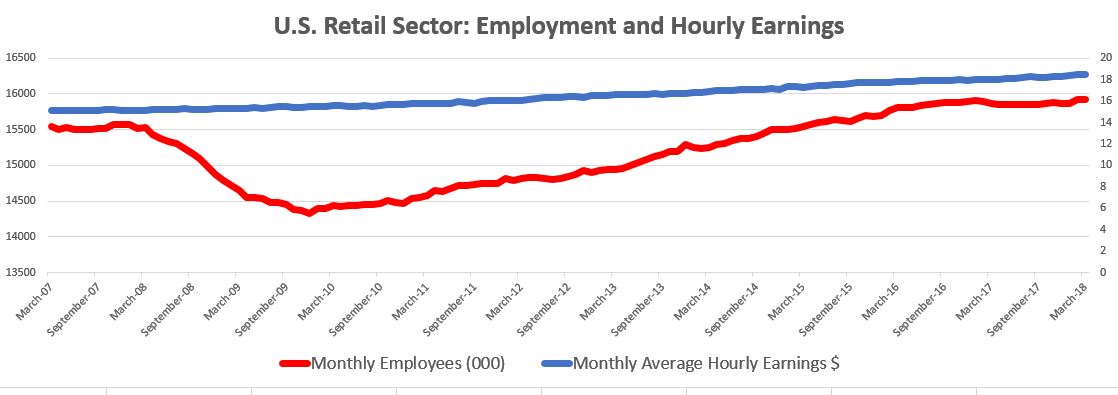
The March payroll jobs report could best be summed up as “less than stellar.” Economists were expecting a monthly gain of between 185,000 and 193,000 jobs. Most economists believe the U.S. economy has reached full employment with some worrying about running out of workers because of fast job growth. However, the number of involuntary part-time workers remained unchanged at 5 million while the number of marginally attached workers checked in at 1.5 million persons, a number not much different from last year. The number of part-time workers in the labor pool increased from 20.7 million in March 2017 to 21.3 million in March 2018. The retail sector returned to its current state of “disliked normalcy” with employment declining by 13,000 jobs in general merchandise stores, “offsetting a gain of the same size in February,” according to the BLS.  Earnings in this sector have bounced back a bit since a decline that began in 2016 (See chart below). The LFP rate decreased from both February 2018 (month over month) and March 2017 (year over year). Today’s report included good news. Average hourly earnings have increased by 71 cents over the past year. Paul Ashworth, chief U.S. economist at Capital Economics, told Bloomberg News that despite the weak payrolls gain, "There is still evidence of an acceleration in the underlying pace of employment growth… looking through the volatility, employment growth is trending higher and wage growth is starting to heat up.”  As a result, pressure will build on the U.S. Federal Reserve Bank to abide by its commitments to raise rates this year.





Thursday, August 17, 2017

Today's Massachusetts jobs number: 4.3% U-rate; 200 jobs lost in July 2017


OVERVIEW
  • The state’s total unemployment rate increased to 4.3 percent in July and lost 200 jobs according to the Executive Office of Labor and Workforce Development. 
  • Since last July the state’s economy has added 45,200 jobs while the state’s labor force participation rate has increased by 1.5 percent. 
  • The strongest job growth came in the Construction (+2,500), with Financial Activities and Education & Health Services each adding 1,300 jobs. 
  • Trade, Transportation & Utilities lost 1,400 jobs over the month while Leisure and Hospitality lost 900 jobs. Information lost 300 jobs; Professional, Scientific and Business Services lost 100.
  • Government lost 1,700 jobs over the month and Other Services lost 1,400 jobs.
  • The new jobs estimate for June was revised to 10,900 from the 10,000 jobs reported originally.  
  • Over the past year, the Health Care and Social Assistance subsector added 20,600 jobs, a sector whose year-over-year growth is nearly four times that of the growth of the Financial Activities sector. 
  • On average, Massachusetts employment grew by 3,767 jobs a month since last July. 
  • On average, the private sector generated 3,575 jobs monthly over the past 13 months. 


ANALYSIS 

The state’s unemployment rate, which inched up in July, has converged with the national rate at 4.3 percent. 

According to the EOLWD, the last time the state and national rates matched was April 2008 when the rate was 5.0 percent. Over the year, the state’s seasonally adjusted unemployment rate increased seven-tenths of a percentage point from 3.6 percent in July 2016. 

Meanwhile, the LFP rate increased by three-tenths of a point to 66.4 percent in July. 

The labor force decreased by 11,300 from 3,708,800 in June, says EOLWD as 11,500 fewer residents were employed and 300 more residents were unemployed.  

The unemployment rate remains at a stable low level but the state faces a skills gap. This may be reflected in the subpar growth of mid-tech jobs classified under Leisure and Hospitality and Other Services. 

“Although the unemployment rate remains low, we continue to see persistent gaps between the skill sets of available workers and the qualifications needed for in-demand jobs,” Labor and Workforce Development Secretary Rosalin Acosta said. 

Job growth in Massachusetts continues to rely on the strength of the Education and Health Care and Professional Services super-sectors, which saw gains of 21,900 and 9,500 over the past year, respectively. In related news, the most recent Boston metropolitan survey released this week by the Bureau of Labor Statistics showed job growth over the past year across all sectors except for manufacturing. 


Indicators

Test